When Oxford Net Zero started in 2021, it was the very first programme to receive seed funding from the University’s new Strategic Research Fund (SRF). Over the past five years, our programme has brought together researchers from across the University and international partners to work on the biggest challenge of our time: how to tackle climate change in a way that is fair and benefits everyone.
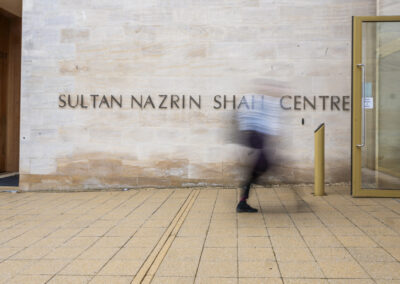
On Wednesday 11 February, we hosted a showcase to celebrate our work at the beautiful Sultan Nazrin Shah Centre, Worcester College. It was an opportunity to reflect on what we have achieved and contemplate the future of research on net zero. Our six Fellows funded by the SRF – Dr Stuart Jenkins, Dr Tom Kettlety, Dr Aline Soterroni, Dr Jessica Omukuti, Dr Selam Kidane Abebe and Kaya Axelsson – each delivered exciting TED-style talks on their research to an audience of academics, policymakers, funders and business executives. It was thrilling to see the depth and breadth of the research on display. Their talks encompassed physical, life and social science; policy; law and justice; and engagement with business, each one reinforcing how important it is to work across disciplines and sectors if we are to make progress on climate change. Moreover, interdisciplinary collaboration is the only way to ensure that the net-zero transition is fair. How do we get there globally at the right time, while accepting that for countries with fewer resources it will take longer? As Dr Kidane Abebe put it, “There is no singular transition to net zero…there are multiple transitions”.
We also had the opportunity to hear remarks from Professor Myles Allen, Founding Director of Oxford Net Zero, and the Vice-Chancellor of Oxford University, Professor Irene Tracey. Professor Allen took us through the origins of Oxford Net Zero and the surprising story of how the term ‘net zero’ first came to be. Oxford Net Zero’s work, he explained, has been all about “The meaning of net zero and how to get it right”. The Vice-Chancellor reflected on how Oxford Net Zero has “really moved at pace”, growing substantially and raising millions of pounds in additional funding since 2021. She emphasised the vital importance of research-intensive universities, including their ability to work on complex, large-scale societal problems like climate change, and their role in speaking out when the evidence demands it.
Two panel discussions highlighted our collaboration and exchange with University and external partners. In the first, moderated by our Executive Director Dr Steve Smith, the panellists debated where the concept of net zero goes next. Solitaire Townsend, Co-Founder and Chief Solutionist at Futerra, argued that the term was no longer useful, and possibly never was. In many people’s minds, she said, ‘net zero’ means “expensive”. Professor Gideon Henderson, now at the Department of Earth Sciences but formerly Chief Scientific Advisor at Defra, had a different view. He said that in his experience, net zero was a clear line that had made it harder for different government departments and sectors of the economy to pass the buck on emissions. For her part, Oxford Net Zero Fellow Alexis Mcgivern said that she was encouraged to see net-zero standards starting to have an impact and function as “quality control” in different sectors.
The second panel, chaired by our Research Director Professor Sam Fankhauser, considered what universities can do to help shape efforts to tackle climate change. Dr Radhika Khosla, one of Oxford Net Zero’s Co-Investigators, said universities should demonstrate that a net-zero transition is possible, but also be honest about “how the evidence is generated” and where there are uncertainties and tradeoffs. Picking up the Vice-Chancellor’s thread on speaking out, she argued that if the evidence we have “is suggesting large amounts of harm, being silent is not a neutral position”. Professor Heidi Johansen-Berg, Oxford’s Pro-Vice-Chancellor of Strategic Initiatives, also argued in favour standing up for the truth. She said that “universities in the UK “should not be shying away…despite the changing political winds, despite the pressures, financial pressures, I very much think universities should be leaning in to the truth and the messages that we are transmitting”. Along with Nigel Topping CMG, Chair of the UK’s Climate Change Committee, all three made the point that that universities have to talk to people with a wide spectrum of views and communicate their research in clear and engaging ways.
We’re delighted to share recordings and photos from the day. Click below to watch a recording with all six Fellows’ talks, plus the opening and closing remarks from the event. Individual recordings of the Fellows’ talks are available in our Showcase playlist. A photo gallery of the event is available to view here.
Huge thanks to those who attended our Showcase, to all our speakers and panellists, and to everyone who has supported us over the last five years. We’re extremely grateful and excited to see what the future brings.
Videos by Oxford Digital Media. Photos by John Cairns.