
greenhouse gas removal
innovation in greenhouse gas removal
To stabilise global temperatures, we need to achieve Net Zero – counteracting any remaining emissions of greenhouse gases into the atmosphere with an equivalent amount of Greenhouse Gas Removal (GGR). In order to cap the rise in global temperatures at 1.5°C above the pre-Industrial level it will be necessary to achieve Global Net Zero by 2050. This means that for every tonne of carbon dioxide that is emitted into the atmosphere in that year there will need to be a tonne of carbon dioxide permanently removed from the atmosphere.
GGR (also known as negative emissions) encompasses a wide range of proposed techniques to remove greenhouse gases from the atmosphere. While there are some proposed methods for removing greenhouse gases other than CO2, the vast majority of GGR methods involve the removal of CO2 from the atmosphere and its long-term storage so that it doesn’t find its way back into the atmosphere.
The range of proposed GGR techniques includes biological approaches, such as planting trees and increasing the amount of carbon stored in the soil, and engineered approaches, such as enhancing the rate at which certain minerals weather and devices that directly capture CO2 from the air. To assess how effective such techniques could be, it is necessary to understand how long-lasting the storage of CO2 away from the atmosphere is and to determine the social acceptability of deploying such techniques at scale.
To achieve the ambition of the Paris Agreement will require GGR techniques to be deployed at a vast scale. The exact amount of GGR required will depend on what the temperature goal is (more GGR will be required to achieve the 1.5°C goal than a 2°C goal), the rate of emissions reduction (the quicker we reduce emissions, the less GGR will be required to counter the remaining emissions) and climate sensitivity (more GGR will be required if the climate is more sensitive to increases in the amount of greenhouse gases in the atmosphere). Current estimates are that between 400-1600 billion tonnes of CO2 will need to be removed from the atmosphere during the course of the century.
There is a need to demonstrate whether proposed GGR techniques are effective and socially acceptable at a significant scale. This will require resources to research and develop proposed techniques, along with detailed consideration of the regulatory frameworks that need to be put in place to appropriately incentivise deployment.
Follow updates on this page for latest research on GGR.
Greenhouse Gas Removal (GGR, also known as negative emissions) encompasses a range of techniques for reducing the concentration of greenhouse gases in ambient air.
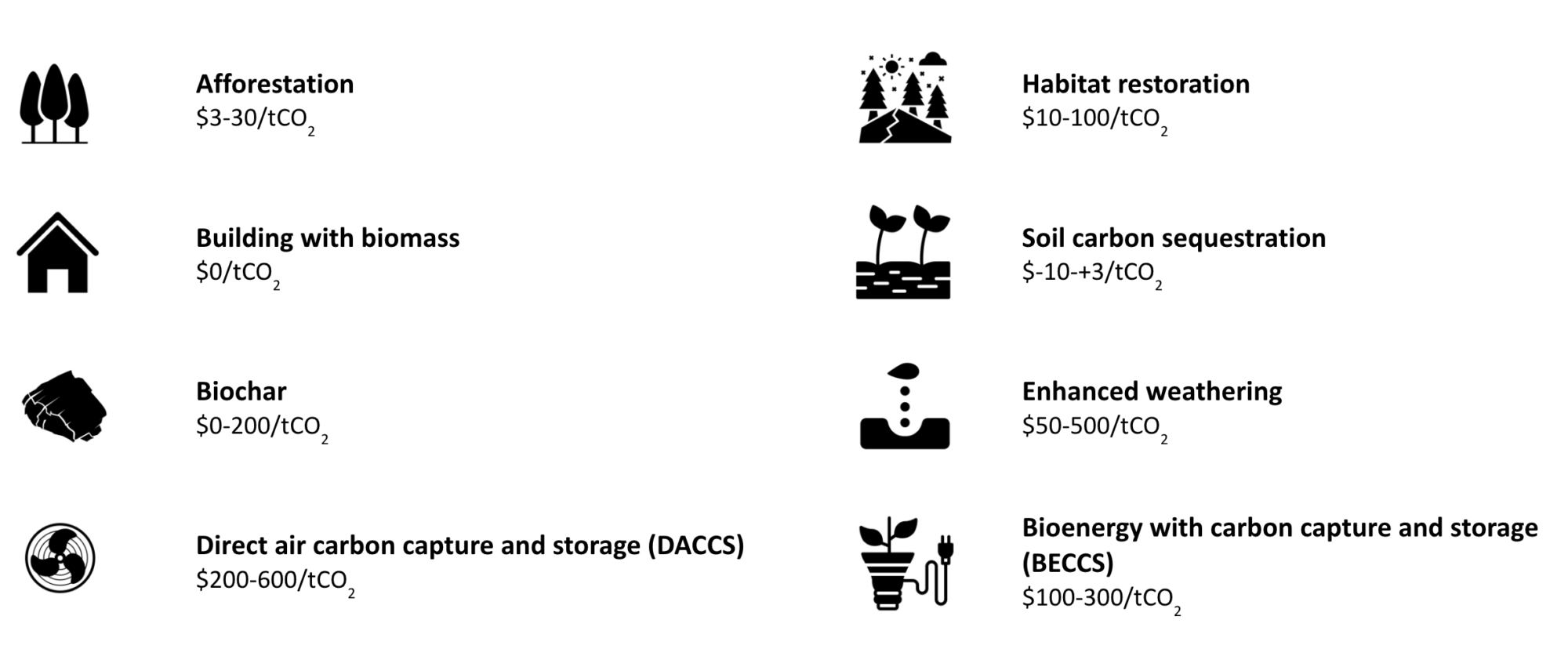
GGR Options
greenhouse gas removal Projects
carbon engineering
Carbon Engineering uses Direct Air Capture (DAC) technology to capture carbon dioxide directly from the atmosphere.
Climeworks
Climeworks develops, builds and operates direct air capture machines to capture carbon dioxide directly from the air.
Options for Greenhouse Gas Removal
The Greenhouse Gas Removal Hub – CO₂RE
Funded through the UKRI SPF Greenhouse Gas Removal Demonstrators (GGR-D) Programme, CO2RE will co-ordinate the Programme and conduct solutions-led research to evaluate a balanced portfolio of economically, socially and environmentally scalable GGR options, with associated policy design, engagement and outreach. This will enable the UK to lead internationally on achieving global net–zero emissions, consistent with the Paris Agreement.

Other research themes
Nature-based Solutions
Nature-based Solutions (NbS) involve working with and enhancing nature to achieve multiple benefits for people, including removing CO2 from the air, and aiding adaptation to climate change.
Equity AND Inclusion
Pathways to achieving global net zero emissions must be framed by questions of equity and justice. A just transition to a net zero future needs to be inclusive of a range of actors as well as a range of views, including those relating climate justice.
Green Recovery and Resilience
A green recovery from COVID-19 could accelerate GDP growth in the immediate future, establish new industries and jobs for the coming decade, and deliver a sustainable climate for the next century.
News and Events

Kaya Axelsson named one of the UK’s 100 most impactful sustainability leaders
We're delighted to announce that Kaya Axelsson, our Net Zero Policy Engagement Fellow, has been named by edie as one of the UK's 100 most impactful sustainability leaders. Edie is a prominent UK business, media and publishing network that ... Read more

Oxford Net Zero marks five years and looks to the future
When Oxford Net Zero started in 2021, it was the very first programme to receive seed funding from the University's new Strategic Research Fund (SRF). Over the past five years, our programme has brought together researchers from across the ... Read more

Expert Comment: Should the UK relax clean energy targets?
(First published on the University of Oxford's news site. View the original here.) Dr Stuart Jenkins, Oxford Net Zero Research Fellow on Net Zero for the Fossil Fuel Sector, assesses whether new North Sea oil and gas strengthens the UK’s ... Read more

Oxford Net Zero reflects on COP30
Members of Oxford Net Zero travelled to Belém, Brazil last month to contribute their expertise at the COP30 summit. This year marked 30 years of COP and 10 years since the Paris Agreement. After so many rounds of negotiations, COP30 was to ... Read more

SBTi Releases Second Draft of Corporate Net Zero Standard: Key Updates for Professional Services
The Science Based Targets Initiative (SBTi) has released the second draft of its updated Corporate Net-Zero Standard, marking the first major revision in more than four years and introducing significant new guidance for professional service ... Read more

New plan aims to make public procurement a force for climate action
Today at COP30 in Belém, the Government of Brazil announced an ambitious plan to drive action on climate change using the power of public procurement. The Belém Declaration on Sustainable Public Procurement establishes concrete measures to move ... Read more
See more news and events