
By Siddharth Shekhar Yadav, Alexis McGivern and Clarissa Salmon.
In mid-October, Oxford Net Zero officially launched the Serviced Emissions Hub – a new cross-sector platform bringing together leaders from law, consulting and advertising to advance climate accountability across professional services providers (PSPs). The launch, held at the London offices of law firm Clyde & Co, marks the next step in Oxford Net Zero’s work to help PSPs understand and act on the climate impact of the advice and services they provide to clients.
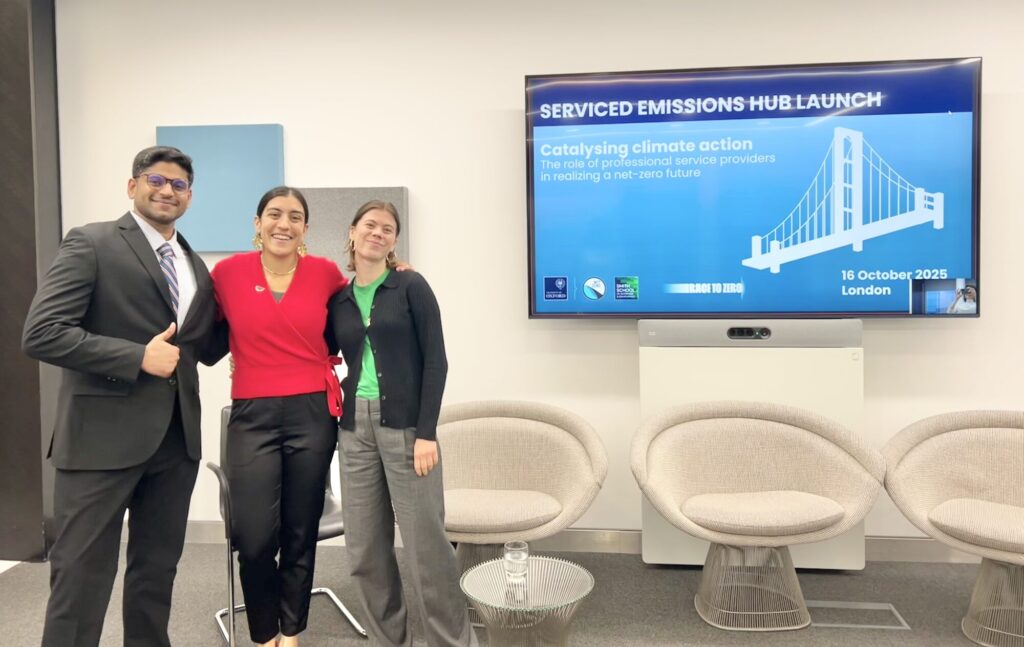
Photo by Siddharth Shekhar Yadav
About the Hub
Hosted by Oxford Net Zero at the Smith School of Enterprise and the Environment, the Hub is a research and engagement initiative focused on advancing credible, practitioner-led approaches to tracking and reducing ‘serviced emissions’. Serviced emissions are the emissions influenced by the expertise and services that PSPs provide to their clients. This ‘beyond operational’ lens on PSPs’ emissions is emerging as a critical issue for the transition to a just and sustainable net zero future. The Hub will coordinate sectoral working groups, share best practices and co-develop methodologies that can be adapted across professional services sectors.
Launch event highlights
The event opened with remarks from Alexis McGivern (Head of Stakeholder Engagement, Oxford Net Zero) and Siddharth Shekhar Yadav (Serviced Emissions Research and Engagement Manager, Oxford Net Zero), who introduced the Hub’s three pillars of work:
- Standards Advocacy: advocating for ‘beyond operational’ PSP impacts to be reflected in leading global net zero frameworks, such as the Science Based Targets initiative (SBTi) and the Greenhouse Gas Protocol (GHGP).
- Client engagement: empowering clients to align procurement and engagement practices of their PSPs with their climate commitments, drawing inspiration from initiatives such as the Global Climate and Health Alliance, which convened more than 75 health organisations now avoiding agencies serving fossil-fuel interests.
- Implementation Working Groups: Partnering across sectors to put the Race to Zero-Oxford Net Zero 2024 Catalysing Climate Action Report principles for PSPs into action. The event introduced the Serviced Emissions Implementation Playbook, which translates the Catalysing Climate Action report into a step-by-step practical resource to guide implementation at the PSP level. This work builds on existing experience and lessons from implementation in the ad and PR sector and is being further iterated by a growing network of PSPs through our partners Purpose Disruptors, Creatives for Climate, Exponential Roadmap Initiative and the Legal Charter 1.5.
Panel discussion: Speakers highlight the importance of radical collaboration
Following the opening remarks, the event moved to a panel discussion, moderated by Alexis and Clarissa Salmon (Stakeholder Engagement Officer, Oxford Net Zero). The panel featured leads for the Implementation Working Groups: Amanda Carpenter (Legal Charter 1.5), Nadeen Ayyashi (Purpose Disruptors), Lucy von Sturmer (Creatives for Climate), and Katarina Wangler Björk (Exponential Roadmap Initiative).
Our panel reflected on both the challenges and opportunities facing PSPs as they begin to measure and manage their serviced emissions. Collecting reliable data remains one of the sector’s main hurdles, even though climate considerations are now increasingly appearing in client tenders and risk profiles. The discussion highlighted the importance of identifying where firms can have the greatest impact, often through materiality assessments, and noted the growing influence of employee expectations – younger professionals are increasingly seeking to work with purpose-driven organisations. Above all, the panel emphasised the need for a culture of radical collaboration, encouraging openness, shared learning and transparency across industries. The panel members observed that while initial engagement with serviced emissions can seem daunting, once they join Implementation Working Groups, many organisations soon realise they are further along in their journey than expected.
Looking ahead, speakers underscored the importance of client engagement, noting that clients must be active participants in developing methodologies and setting expectations through procurement policies, such as conditions within requests for proposals. Panellists also pointed to innovation and cross-sector alignment as potential drivers of progress. The discussion recognised that many organisations are still at the beginning of their journey, and that credibility in this space is built through transparency and openness rather than pursuit of perfection and flawless performance. Participants also noted that tools such as qualitative, visual progress mapping could play an increasing role in implementation.
Shared priorities for the year ahead include strengthening collaboration across sectors, developing robust methodologies supported by strong business cases, and maintaining momentum through transparent public reporting and civil society collaborations.
The event concluded with optimism about the path ahead. As firms begin to engage with serviced emissions, collaboration across sectors and with clients will be key. The Serviced Emissions Hub will continue to convene working groups, shape methodologies, and build shared understanding to accelerate credible, high-impact climate action within professional services.
You can find out more about the Hub here.