
Net Zero Regulation Stocktake
NET ZERO REGULATION STOCKTAKE: What does the road to Net zero look like?
Regulations related to the transition to net zero are already in place in a number of jurisdictions and are recommended by the United Nations to accelerate the transition to a low-carbon economy. There is, however, a gap in knowledge of the regulations that already exist or are in progress, as well as instruments that could be reformed to encompass net zero goals.
To fill this gap, between May and August 2023, Oxford Net Zero took stock of national-level climate regulations and policy instruments coming from G20 members. The 2023 Stocktake is a precursor to expanded, systematic tracking of net zero-related regulations. The forthcoming tracker will be an initiative by the Net Zero Regulation and Policy Hub at the University of Oxford.
Regulatory Domains
Types of instruments tracked so far:
1. Claims & Financial Product Standards
Advertising products, services, or corporate performance as “net zero” or similar is subject to specific criteria, including compliance with financial product standards.
2. Disclosure
Companies and financial institutions report on the risk of climate impacts and decarbonisation.
3. Procurement
Governments condition procurement to firms and products that meet well-defined net zero or decarbonisation standards.
4. Transition Plans
Regulators require firms to outline their pathways to net zero or decarbonisation.
Key results
Regulation aRE disseminated around the world
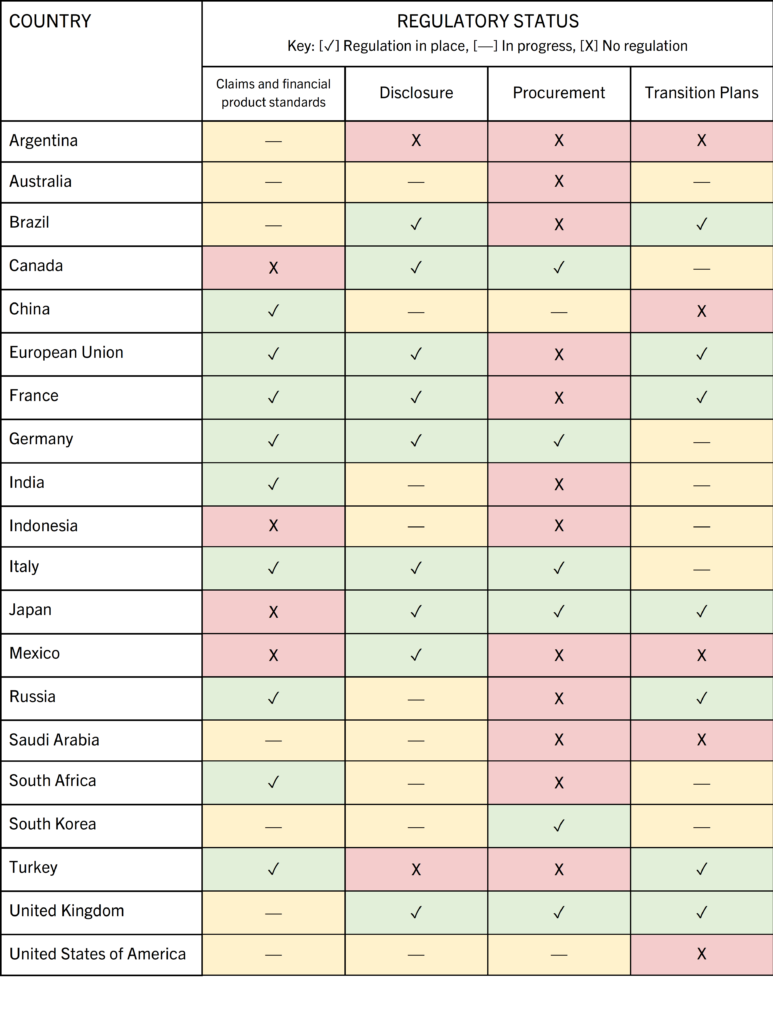
The majority (15 out of 20) of G20 members have implemented regulations in at least one of the tracked regulatory domains. Additionally. all of the countries that are yet to regulate have instruments under development, indicating ongoing efforts towards regulation.
This dynamic regulatory scenario emphasises the importance of continued monitoring, analysis, and collaboration to drive effective and comprehensive regulation towards achieving global decarbonization.
THE REGULATIONS ARE COMING FROM DEVELOPING AND DEVELOPED NATIONS
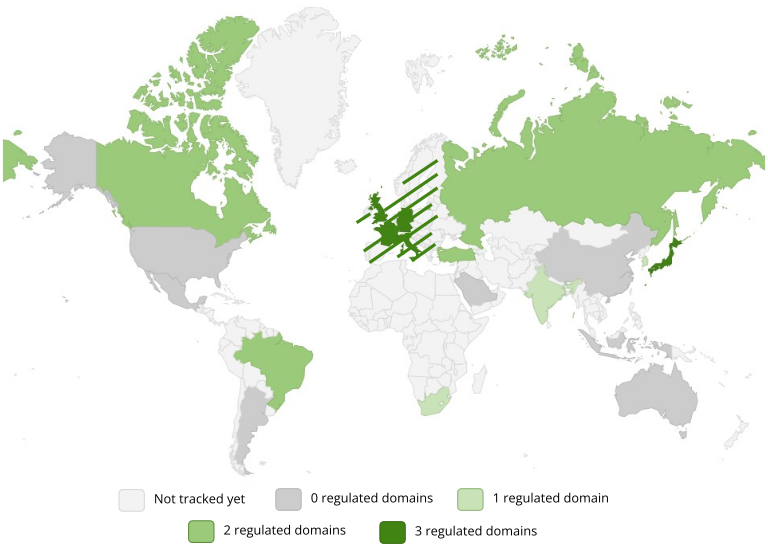
All in all, governments are developing climate regulations to support their decarbonization pathways. This is being done across the G20, by both developing and developed nations. While there is evident progress, comprehensive regulation has yet to be adopted, as no G20 member has regulated in all four of the covered domains so far.
G20 members account for 85% of the world’s economy. Moving the needle towards regulated net zero actions in these countries plays a pivotal role in driving the transition to a low-carbon economy worldwide.
VOLUNTARY STANDARDS ARE GAINING MOMENTUM IN NATIONAL REGULATIONS
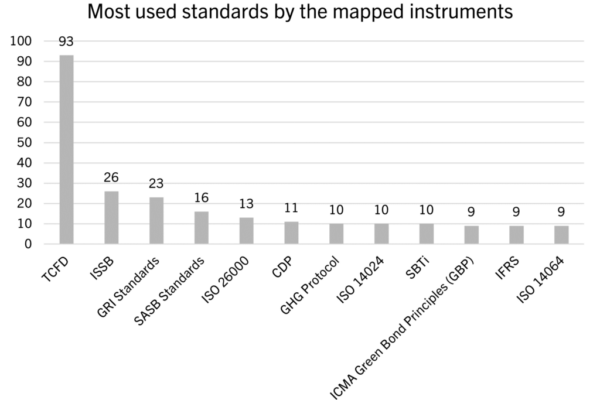
Voluntary standards have been fundamental in creating and promoting best practices for net zero action but have limited reach. The data indicates that the shift from voluntary standards to their incorporation into mandatory national regulations is underway.
Over 160 mapped instruments make use of standards to support their text. Individual standards have been referenced (cited, used as a basis, encouraged or required) over 390 times, with the Task Force on Climate-Related Financial Disclosures (TCFD) being the most frequently cited. 24 out of the 77 mapped climate regulations either mandate compliance with a standard or align themselves to one.
sTOCKTAKE RESOURCES
DATASET – BETA VERSION
The bulk of data collection took place between May and June 2023 by Lucilla Dias and Adriana Elera, with some supplementary data reviews in July and August 2023. The dataset is in a beta version and is subject to change.
We appreciate your feedback! If you have information to complement the dataset or spot any misinterpretations, please get in touch with us at lucilla.dias@bsg.ox.ac.uk and kaya.axelsson@ouce.ox.ac.uk.
REPORT
Access the 2023 Stocktake Report for a detailed version of our findings.
CODEBOOK
Access the codebook for a definition of the mapped fields.
BRIEF
Please see our brief on early findings prepared for London Climate Week, 2023.
DISCOVER more RESEARCH

What is net zero?

the urgency of zero

Carbon Dioxide Removal

Carbon offsetting
News and Events

Kaya Axelsson becomes Oxford Net Zero Director of Impact
We're delighted to announce that Kaya Axelsson has this week started a new role as Oxford Net Zero's Director of Impact. She joins Dr Steve Smith MBE and Professor Sam Fankhauser, who will continue as Executive Director and Research Director, ... Read more

Oxford Net Zero academics co-lead open letter to DESNZ Secretary of State on carbon storage
Dozens of academics, environmental professionals and members of civil society have this week published an open letter to the Secretary of State at the Department of Energy Security and Net Zero, Miatta Fahnbulleh, arguing for specific ... Read more

Dr Radhika Khosla awarded the title of Professor of Environmental Science and Policy
Dr Radhika Khosla, formerly Associate Professor and researcher at the Smith School of Enterprise and the Environment, University of Oxford, has been awarded the title of Professor of Environmental Science and Policy. The title was awarded ... Read more

Here’s how to make North Sea drilling compatible with net zero
By Professor Myles Allen, Founding Director of Oxford Net Zero and Head of Atmospheric, Oceanic and Planetary Physics, University of Oxford. Originally published by the Financial Times on 29 July 2026. Republished with permission. Click here ... Read more

Job opening: Executive Officer, Impact and Engagement (now closed)
THIS OPPORTUNITY IS NOW CLOSED. Oxford Net Zero is seeking an organised and proactive Executive Officer to support its policy engagement and impact activities focused on corporate climate action, accountability, and net zero governance. ... Read more

ISO Net Zero Draft International Standard now available for public consultation
The ISO Draft International Standard (DIS) 14060 Net zero aligned organisations is now available and ready for public consultation. You can download the draft standard from the BSI website here (opens new page). This standard builds on ... Read more